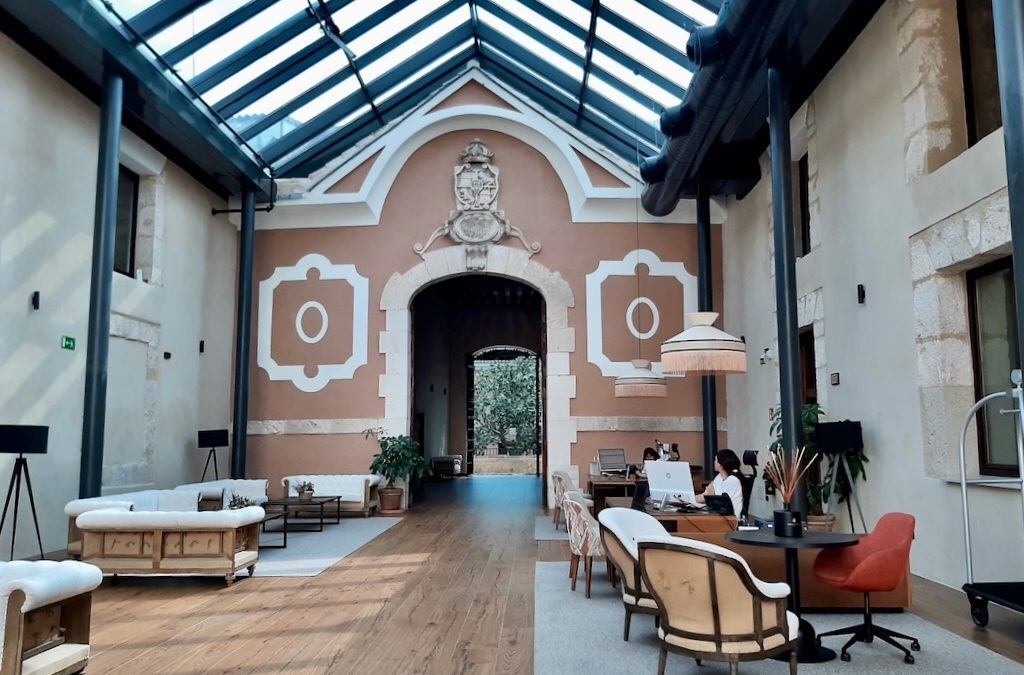
Some hotels begin their story on the day they open. Others have been collecting stories for centuries before welcoming their first modern guests.
Castilla Termal Brihuega 5★ belongs to the latter. Today it is an elegant Wellness hotel in the historic town of Brihuega, less than an hour from Madrid. Yet its story began almost three centuries ago, when the site became home to the Real Fábrica de Paños de Brihuega — the Royal Cloth Factory, one of Spain’s most remarkable examples of 18th-century industrial architecture.
1750: where the story began
The Royal Cloth Factory was founded in 1750, during the reign of King Ferdinand VI, at a time when the Spanish Crown was promoting new manufacturing centres as part of a broader effort to modernise the country’s economy.
Brihuega was a natural choice. Textile production already had deep roots in the area, while the surrounding landscape provided essential resources including water, timber, raw materials and skilled labour.
The complex was built within the historic town walls, on an elevated position overlooking the Tajuña River valley.
That was the beginning of a building that, almost 300 years later, would be given an entirely new purpose.
The Rotonda: architecture designed around natural light
One of the most distinctive features of the former factory is its celebrated Rotonda.
The main structure was designed as two concentric rings surrounding a central courtyard. Its unusual geometry was not purely decorative. The large number of windows allowed natural light to enter the workspaces, an essential element for the weavers and spinners who worked there.
At the height of its industrial activity, the complex housed dozens of looms. Over time, additional warehouses, administrative areas, staff accommodation and production spaces were added.
The factory gradually developed into something resembling a small city within the town.
It is fascinating to imagine that the spaces which now feel calm and contemplative were once filled with the rhythm of machinery, looms and hundreds of workers.
A building shaped by several centuries
The history of the Real Fábrica de Paños was not a quiet one.
During the Peninsular War, the complex suffered damage and was used by French troops. It later passed into private ownership, changed hands and continued its activity through very different periods of Spanish history.
Eventually, industrial production came to an end and the building entered a long period of decline.
This is precisely what makes its present-day restoration so significant. Castilla Termal did not simply inherit a historic façade. It revived an authentic architectural complex that carries the memory of several centuries within its walls.
Historic gardens overlooking the Tajuña Valley
The gardens of the Real Fábrica de Paños form another important part of the property’s identity.
Their present appearance developed mainly during the 19th century. Geometric pathways, cypress trees, fountains, pavilions and viewpoints create an almost palatial atmosphere.
From their elevated position, the gardens offer wide views over the Tajuña Valley and the surrounding landscapes of La Alcarria.
This close relationship between nature, gardens and local history is one of the reasons Brihuega is often known as “the Garden of La Alcarria.”
In summer, another signature element of the region comes into view: the famous lavender fields of Brihuega, which have transformed this small town in Guadalajara into one of central Spain’s most recognisable landscapes.
A new chapter: Castilla Termal Brihuega 5★
The transformation of the former Royal Cloth Factory became an ambitious heritage restoration project.
The aim was not to conceal the old structure behind a contemporary interior, but rather to preserve its architectural character and allow the 18th-century building to remain part of the guest experience.
In September 2023, Castilla Termal Brihuega 5★ opened its doors, becoming the first five-star hotel in the province of Guadalajara.
Today the property features 78 rooms, gastronomic spaces, relaxation areas and a comprehensive Wellness infrastructure carefully integrated into the historic complex.
Most importantly, however, the building’s past was not reduced to a decorative detail.
It became part of the hotel’s identity.
When history becomes part of the Wellness experience
At Castilla Termal Brihuega, the heritage of the site also influences its approach to wellbeing.
One of the most symbolic examples is the 1750 Massage, named after the year in which the Royal Cloth Factory was founded and inspired by the building’s textile history.
The Wellness concept also draws on elements closely connected to La Alcarria, including two of the region’s most characteristic products: lavender and honey.
As a result, Wellness here is not limited to treatments or facilities. It becomes an experience connected to history, landscape and local identity.
From a place of production to a place designed for slowing down
This may be the most beautiful contrast of Castilla Termal Brihuega.
Nearly three centuries ago, these walls were created for production, constant movement and the work of hundreds of people.
Today, guests arrive looking for the opposite: quiet, time for themselves, beautiful architecture, gastronomy, Wellness and the opportunity to slow down.
Yet there is still a connection between these two chapters.
The Real Fábrica de Paños was an innovative project for its time, bringing together architecture, industry and local development. Castilla Termal now continues that story in a 21st-century language, preserving the heritage while giving it a new purpose.
At Máxima Bienestar, these are precisely the destinations we value most: places where Wellness is not simply about a Spa or a list of treatments, but about experiencing a journey that brings together history, architecture, nature, gastronomy and personal wellbeing.
Castilla Termal Brihuega shows how a building with almost 300 years of history does not have to become a museum in order to preserve its memory. It can continue to live, evolve and tell its story in an entirely new way.