The Gran Hotel Balneario de Puente Viesgo in Cantabria bases many of its thermal and wellness programmes on its own mineral-medicinal spring water.
The spring was officially declared of Public Utility in 1869. Its water naturally emerges at a constant temperature of approximately 33.8°C, with a pH of 7.4 and medium mineralisation, including a dry residue of around 1,278 mg/l.
According to its predominant ionic composition, the water is classified as sodium chloride-rich, with bicarbonates, calcium and magnesium also present, together with dissolved nitrogenous gases.
This mineral profile forms part of the spa’s historical identity and supports the different applications used within its thermal wellness programmes.
Under professional supervision, these mineral-medicinal waters have traditionally been incorporated into programmes focusing on the musculoskeletal system, physical recovery, certain respiratory conditions, peripheral circulation, relaxation and stress management.
Thermal water in different forms
At the medical thermal centre, the water is used at controlled temperatures through different hydrotherapy and balneotherapy techniques.
These include bubble baths and hydromassage, thermal pools and water circuits, as well as specialised thermal showers and pressure jets.
Inhalation techniques such as inhalations, aerosols and nebulisation are also used, together with complementary treatments including thermal mud and parafango applications.
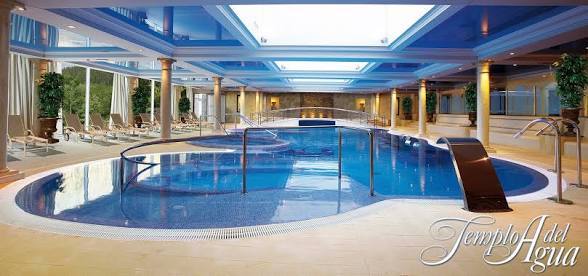
Spaces such as the Templo del Agua and the Circuito Cántabro integrate thermal water into a broader experience of relaxation, movement and wellbeing.
Puente Viesgo is therefore an excellent example of thermal tourism in Spain, where spa heritage, professional thermal care and contemporary Wellness come together around one essential natural resource: water.
The spring was officially declared of Public Utility in 1869. Its water naturally emerges at a constant temperature of approximately 33.8°C, with a pH of 7.4 and medium mineralisation, including a dry residue of around 1,278 mg/l.
According to its predominant ionic composition, the water is classified as sodium chloride-rich, with bicarbonates, calcium and magnesium also present, together with dissolved nitrogenous gases.
This mineral profile forms part of the spa’s historical identity and supports the different applications used within its thermal wellness programmes.
Under professional supervision, these mineral-medicinal waters have traditionally been incorporated into programmes focusing on the musculoskeletal system, physical recovery, certain respiratory conditions, peripheral circulation, relaxation and stress management.
Thermal water in different forms
At the medical thermal centre, the water is used at controlled temperatures through different hydrotherapy and balneotherapy techniques.
These include bubble baths and hydromassage, thermal pools and water circuits, as well as specialised thermal showers and pressure jets.
Inhalation techniques such as inhalations, aerosols and nebulisation are also used, together with complementary treatments including thermal mud and parafango applications.
Spaces such as the Templo del Agua and the Circuito Cántabro integrate thermal water into a broader experience of relaxation, movement and wellbeing.
Puente Viesgo is therefore an excellent example of thermal tourism in Spain, where spa heritage, professional thermal care and contemporary Wellness come together around one essential natural resource: water.